Monday, November 16, 2015

Here's your preview of this week's big market-moving events

Here's your preview of this week's big market-moving events

paris euronextREUTERS/Jacky NaegelenStock market operator Euronext's analysts work in the market services surveillance room at the new Euronext headquarters in Courbevoie near Paris, France, November 12, 2015.
At least 129 people were killedafter terrorists orchestrated a series of attacks in Paris on Friday.
Many more were critically injured.
But the world goes on.
Here's your Monday Scouting Report:
Top Stories
  • How the markets react to terrible tragedies. Experts expect a knee-jerk reaction to Friday's events when markets open on Monday. While it feels a bit awkward and callous to discuss this so soon, the timing of this discussion matters if it can offer guidance to those on the brink of dumping the risk in their portfolios. (Note: French financial markets will open as usual on Monday.)

    Sadly, there is no shortage of horrible events in history. Ritholtz Wealth Management's Josh Brown reviews some of the worst ones that occurred in the past century and notes that stocks often end flat to higher within days or just a few months. Crossing Wall Street's Eddy Elfenbein went into this in depth two years ago. Warren Buffett wrote about it in the New York Times seven years ago.

    So what's this about? Brean Capital's Peter Tchir offered a thoughtful take on Sunday: "In spite of many doomy predictions surrounding past events, the resilience of the people has won out over terror. People have not given up in the past. People do not huddle up cowering in their homes. They get out and go about their business and defy the people who perpetrated such acts. If the security forces can do their job I would not bet against the people. If there is not another attack in the immediate aftermath, then I would expect the people to once again manage to overcome the attack. Human nature is full of struggle against oppression and will hopefully prevail again."
  • A warning from retail. On Friday, we learned retail sales in October were a bit weaker than expected. (For what it's worth, the September and August reports also whiffed.) “[I]t is very risky to use retail sales as a proxy for real consumption - which is what really matters,” said Pantheon Macroeconomics’ Ian Shepherdson, who argues the real story is being held back by the weak inflation story.

    But there could be something more significant happening here with the American consumer, who has been one of the most bullish forces in the global economy. Here'swhat analysts said after department store giant Nordstrom reported a horrible third quarter: "With a superior business model, in our view, that is half high-end dept. store, 30% off-price, and 20% online, this level of deceleration is a potential cautionary tale of the US consumer's health," Deutsche Bank said. "We think we are either seeing the impact of one of the warmest fall selling seasons in recent history (more likely) or we are teetering on the precipice of a recession,” KeyBanc said.
french embassy warsaw polandREUTERS/Kacper PempelPeople stand in line to sign a condolence book in memory of the victims of the attacks in Paris, at the French embassy in Warsaw, Poland November 15, 2015.
Economic Calendar
  • Empire Manufacturing (Mon): Economists estimate this regional manufacturing index improved to -6.35 in November from -11.36 in October. Here's Deutsche Bank's Joe LaVorgna: "The New York Fed Empire survey is expected to remain in negative territory for the fourth consecutive month and for the fifth time in the last six months. On an ISM-adjusted basis, the headline Empire series stood at 46.3 last month, which tells us the economy could be in an industrial recession. Within the Empire data, pay close attention to the new orders, employment and shipments figures—both new orders and shipments are below the headline number, pointing to further downward momentum in the latter. The six-month outlook is also worth paying attention to—it stood at 23.4 in October, up slightly from September’s 23.2 reading, which was the lowest level since January 2013 (22.7)."
  • Consumer Price Index (Tues): Economists estimate consumer prices climbed by 0.2% month-over-month in October or 0.1% year-over-year. Excluding food and energy, core prices are estimated to have increased by 0.2% and 1.9%, respectively. Here's Wells Fargo's Sam Bullard: "Consumer price inflation has remained soft, with the headline index weighed down by energy and import prices. After falling 9% in September, gasoline prices should exert a substantially smaller drag in October. Core CPI continues to be supported by shelter costs and medical care, a trend which should continue. While headline inflation should remain subdued for the next couple of months, low base effects should begin to work into the year­over­year calculation–staring in Q1 2016–and result in a sharply higher inflation performance than we have seen in 2015."
  • Industrial Production (Tues): Economists estimate production increased by 0.1% in October as capacity utilization stood at 77.5%. Here's Nomura: "Regional manufacturing surveys were mostly weak again in October; however, the ISM manufacturing survey, which provides a measure of national manufacturing sentiment, declined only slightly on the month and the Chicago PMI surprised to the upside. In addition, the Bureau of Labor Statistics (BLS) reported that aggregate hours worked in manufacturing rose in October. As such, we expect an increase in manufacturing production in October. Based on the BLS aggregate hours worked in mining, we forecast that mining production was roughly unchanged. We also expect little change in vehicle production again in October. Weekly utility output data point to a decline in utilities production in October, possibly due to a warmer-than-usual October and thus less heating demand."
  • NAHB Housing Market Index (Tues): Economists estimate this index of homebuilder sentiment was unchanged at 64 in November. Here's Bank of America Merrill Lynch: "After reaching a cyclical high of 64 in October, we think the risk is that homebuilder sentiment edges down to a 62 reading. This is still indicative of a robust housing market. However, we think builders have become increasingly frustrated by the lack of labor and inability to increase supply, as discussed in the housing watch."
  • Housing Starts (Wed): Economists estimate the pace of starts dropped 3.8% to 1.160 million units in October. Building permits climbed 3.9% to 1.149 million units. Here's Nomura: "The broad improvement in housing starts this year suggests that improving household fundamentals, favorable demographics, and low mortgage interest rates are finally feeding through to the housing market. Multifamily starts increased at a very strong pace in most regions in September – indicative of household formations occurring increasingly in the rental space as people transition to renting before homeownership due to financial constraints – but we expect to see some payback in this metric in October as the multifamily series tends to be volatile … We are constructive on housing activity in the medium term, largely based on: 1) pent-up demand from a depressed pace of household formation; and 2) improvement in the employment and income outlook for younger workers."
  • FOMC Minutes (Wed): The Fed will release the minutes of its Oct. 27-28 Federal Open Market Committee meeting at 2:00 p.m. ET. Here's RBC's Tom Porcelli: "The Fed went out of its way to make the October FOMC statement much more hawkish than expected. Beyond this, a handful of committee members (including Yellen and Dudley) have come out since then to echo that sentiment. So it would be a surprise if the Minutes did not reflect a committee that is poised to hike in December barring a negative headline in the next few weeks. Remember, the meeting took place before we received a very strong October payroll report. So the minutes are somewhat stale and we would imagine sentiment amongst the FOMC is even marginally more hawkish now than just a few weeks ago. Surely the mid-200K NFP print will help the committee to pitch a December rate hike (our base case) even more convincingly. On the heels of a stellar October payroll report, a rate increase at the December meeting seems as close to a lock as one is going to get—at this juncture."
  • Initial Jobless Claims (Thurs): Economists estimate initial claims slipped to 270,000 from 276,000.
  • Philadelphia Fed Business Outlook (Thurs): Economists estimate this regional activity index improved to -0.8 in November from -4.5. Here's HSBC: "Growth in US manufacturing activity has slowed noticeably this year. Slower global industrial output growth, downward pressure on international commodity prices, and an appreciation of the USD have each created challenges for export-oriented manufacturers."
  • Kansas City Fed Manufacturing (Fri): Economists estimate this regional activity index improved to 0 in November from -1.
Fedspeak Calendar. From Wells Fargo's Sam Bullard: "Another bountiful week of Fed official speaking engagements awaits the financial markets. On Tuesday, Federal Reserve Governor Powell (voter, moderate) speaks in New York on “Central Clearing in an Independent World.” Later in the day, Former Fed Chairman Bernanke and Fed Governor Tarullo (voter, dove) speak at the Brookings Institution on “Are we safer? A look at the financial system, post­crisis.” Wednesday proves to be a busy day with the October 27­28 FOMC meeting minutes release and four Fed speakers–New York Fed President Dudley (voter, dove), Atlanta Fed President Lockhart (voter, moderate) and Cleveland Fed President’s Mester (voter, hawk) speak on a panel in New York to The Clearing House’s annual conference; separately, Dallas Fed President Kaplan (non­voter) speaks in Houston on “A Discussion of Economic Conditions and Federal Reserve Policy.” On Thursday, Atlanta Fed President Lockhart speaks in Atlanta on the U.S. economy; followed by Fed Vice Chairman Fischer (voter, moderate) speaking at a San Francisco Fed conference on a speech titled “Emerging Asia in Transition.” On Friday, St. Louis Fed President Bullard (2016 voter, hawk) speaks in Arkansas on the U.S. economy. On Saturday, San Francisco Fed President Williams (voter, dove) speaks in Berkeley on U.S. monetary policy. The financial markets will continue to gather clues as to individual and voting FOMC member leanings heading into the final monetary policy meeting of the year."
new york stock exchange traders yellen federal reserveREUTERS/Lucas JacksonTraders work on the floor of the New York Stock Exchange shortly after an announcement by the Federal Reserve Bank in New York, October 28, 2015.
Market Commentary
As 2015 nears its close, more and more Wall Street strategists are looking to 2016.
Credit Suisse global equity strategist Andrew Garthwaite on Thursday: "We see five major headwinds for equities: Equity valuations are close to fair value … Macro uncertainty and abnormal bottom-up risk … Earnings momentum is weak … The political landscape is becoming less corporate-friendly … Market breadth falling.” “Why we remain constructive on equities: Bull markets seldom peak at fair value … Equities are still pricing in a considerable fall in economic momentum … Excess liquidity is supportive … Corporate sector net buying is set to remain high … A fall in earnings is needed for an equity bear market … First Fed rate hikes do not mark the end of a bull market." Garthwaite reiterated his firm's mid-2016 S&P 500 target of 2,200.
Barclays head of equity strategist Ian Scott on Thursday: "With the US interest rate cycle likely to turn in December, our most robust conclusion is a market driven more by considerations of value than quality or growth. In terms of sectors, we think the market shift to a focus on value favors Financials, some late-cycle cyclicals such as Materials, Industrials and Energy. On the other hand, Staples and Healthcare, as well as Utilities and Telecom, could struggle globally. Regionally, this suggests “international” equities over the US." Scott sees the S&P 500 ending 2016 at 2,200.

Follow Monday Scouting Report and never miss an update!

French police have made 150 raids since the Paris attacks and found a rocket launcher in Lyon overnight

French police have made 150 raids since the Paris attacks and found a rocket launcher in Lyon overnight

PARIS — French police officers raided homes of suspected Islamist militants across the country overnight in the aftermath of the Paris shootings, French Prime Minister Manuel Valls said on Monday as he warned of potential further attacks.
Valls said that since this summer, French intelligence services had prevented five attacks.
"We know that more attacks are being prepared, not just against France but also against other European countries," Valls said on RTL radio.
Police sources told Reuters that authorities conducted at least 110 house searches in cities around France overnight. One of these searches, in the Paris suburb of Bobigny, was part of the judicial investigation into the attacks at a football stadium, bars, and a concert hall where at least 129 people died.
French police made 23 arrests and seized assault rifles and drugs in a nationwide overnight sweep on suspected Islamist militants following Friday's attacks, the government said.
Interior Minister Bernard Cazeneuve said 168 homes were raided in France's major cities and elsewhere, and 104 people had been put under house arrest in the last 48 hours.
Police seized 31 firearms as well as computer hard drives and telephones, and illegal drugs were found in 18 of the raids, Cazeneuve told journalists.
One Islamist militant suspected of arms and drugs dealing was found to have Kalashnikov assault rifles, automatic handguns and bullet proof vests.
In one raid on the house of the parents of a suspect, police found military fatigues and a rocket launcher in addition to more bullet proof vests and automatic handguns.
According to the French TV news channel BFMTV, Valls announced that more than 150 searches had taken place since the state of emergency was announced on Friday.
Findings Sunday night included the arrest of five men in Lyon and the discovery of numerous weapons, including a rocket launcher.
The death toll was put 132 on Sunday, but reports on Monday said the increase may have been a counting error.
French media said the police also raided houses in Toulouse, Grenoble, and Bobigny.
"We are making use of the legal framework of the state of emergency to question people who are part of the radical jihadist movement ... and all those who advocate hate of the republic," Valls said.
On Friday, three coordinated teams of gunmen and suicide bombers carried out the wave of attacks across Paris in what President Francois Hollande called an "act of war" by Islamic State.
(Reporting by Geert De Clercq, Nicolas Bertin et Myriam Rivet,; and Sophie Louet; editing by Andrew Callus)

The Market’s Response to Crisis

The Market’s Response to Crisis

On Friday night, I was at a giant financial media party with a thousand revelers in black tie celebrating a year’s worth of coverage of markets and the economy. I pulled an Irish Exit sometime before the entrees were brought out because I just didn’t feel much like partying.
The events that evening in Paris have really shaken me up. Not sure why I’m more affected by this latest terror episode than usual, but I am. To me, it felt the most like 9/11 of all of the attacks since.
There wasn’t any real-time Twitter feed 14 years ago and wireless networks were effectively useless in Manhattan that day. We heard about the separate crashes in Pennsylvania and at the Pentagon through word of mouth or whenever we got to a place that had a TV on as we made our way up 2nd Avenue. This time, the events happening around the city of Paris were coming at us a mile a minute, the bodycount multiplying with every refresh of the timeline.
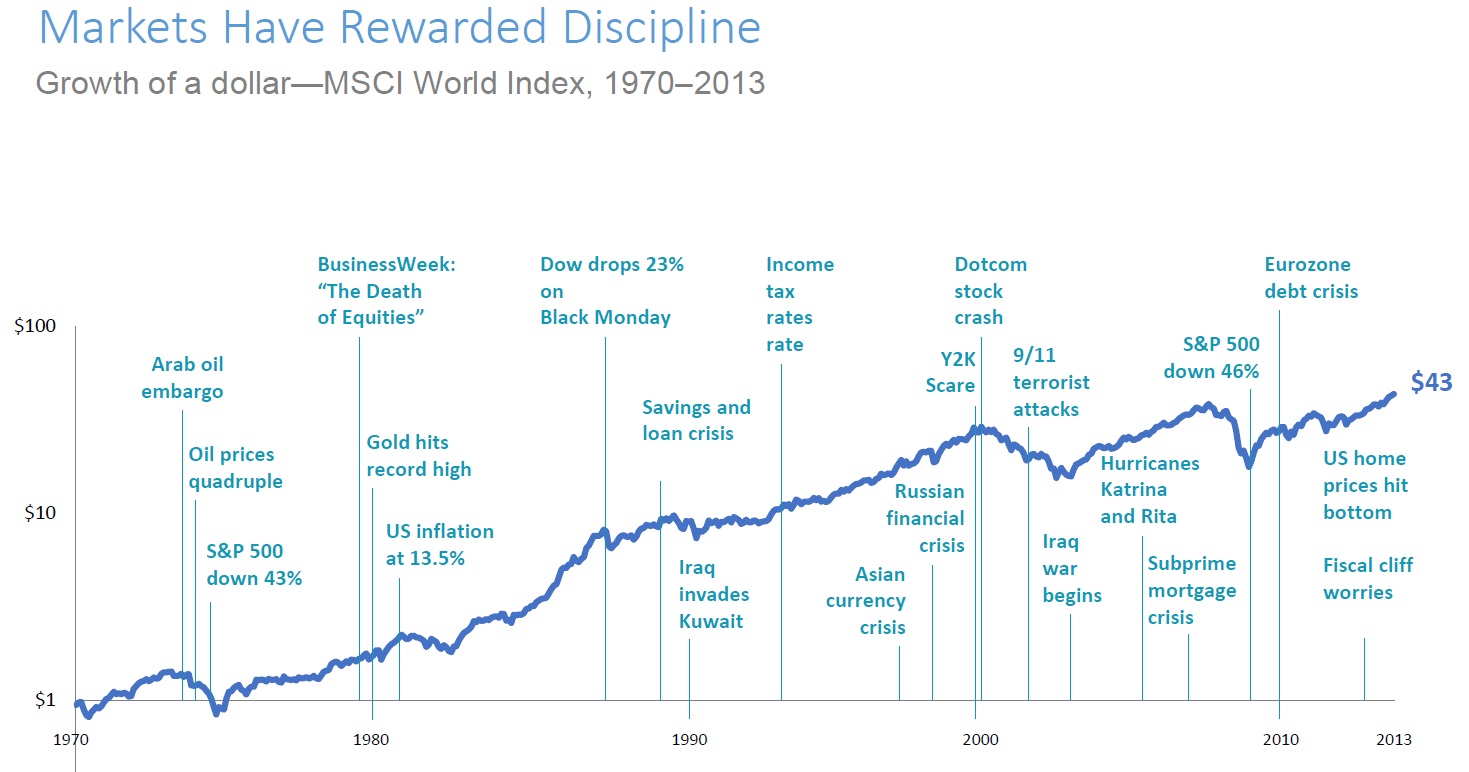
I don’t really have anything much to say today about my usual bailiwick. Instead, I’ll share a slide from the investing presentation we go over with clients of the firm. The chart comes from Dimensional Fund Advisors:
dimensional
Eddy Elfenbein once looked at the market’s response to major geopolitical crises at his blog, Crossing Wall Street. He reminds us that the market rallied 4.5% on the first day it opened following JFK’s assassination and funeral in the fall of 1963. The Dow Jones actually finished up that year by 17%, despite the deep psychological wounds from the event.
Stocks were flat within a week of his brother Bobby Kennedy’s murder in 1968 and they rallied 4.5% during the week following Martin Luther King Jr’s death that same year. Two months after 9/11, the US stock market had regained its losses and had retraced back to where it was on September 10th, the last day before the world had been forever altered.
We don’t know what the fallout from the Paris attacks will be in the days and weeks to come. We don’t know what the military response will be and where this is all headed.
I’ll leave you a quote from Charles de Gaulle, the leader of the Free French government in exile during World War II, who refused to accept his country’s armistice with Nazi Germany. Upon contemplating the aftermath of the Great War and tallying up the costs in blood and treasure, de Gaulle remarked “It is not tolerable, it is not possible, that from so much death, so much sacrifice and ruin, so much heroism, a greater and better humanity shall not emerge.” He was right then, as the powers of Western Europe enjoyed a peace lasting seven decades and counting.
I believe he’ll be right again. A greater and better humanity surely must be the result on the other side of whatever is to come.

IMF experts recommend inclusion of China's yuan into the elite SDR currency basket

IMF experts recommend inclusion of China's yuan into the elite SDR currency basket

The head of the International Monetary Fund, Christine Lagarde, delivers a speech during the international conference on Islamic finance, in Kuwait City on November 11, 2015© AFP/File Yasser al-ZayyatThe head of the International Monetary Fund, Christine Lagarde, delivers a speech during the international conference on Islamic finance, in Kuwait City on November 11, 2015
Washington (AFP) - IMF experts recommended Friday that the Chinese yuan be included in the Fund's SDR basket of currencies, backing a strong push by Beijing to join the elite grouping.
Now the world's second-largest economy, China asked last year for the yuan to be added to the grouping, but until recently the yuan's exchangeability on international markets has been deemed too tightly controlled by Beijing for it to fully qualify.
IMF chief Christine Lagarde said in a statement that the staff experts, in their report to the IMF board, ruled the yuan or renminbi (RMB) now "meets the requirements to be a 'freely usable' currency."
That was a key hurdle to the yuan joining the yen, dollar, pound and euro in the Fund's "special drawing rights" currency basket, seen as the leading currencies of international commerce.
After years of keeping the yuan tightly controlled, China has moved over the past few years to allow it to be more widely used in international transactions.
Lagarde said the staff experts ruled that Beijing has addressed "all remaining operational issues" required for SDR inclusion, which will be decided by the executive board at a November 30 meeting.
"I support the staff’s findings," she said, adding to expectations that the board will also back the yuan.
The Fund has been generally receptive to the idea that the yuan could join the other four currencies in the grouping.
While not a freely traded currency, the SDR is important as an international reserve asset, and because the IMF issues its crisis loans -- crucial to struggling economies like Greece -- valued in SDRs.
On August 4 the IMF said the yuan fell short of meeting all the standards for inclusion, particularly on being "freely usable" in international finance.
China's economic slowdown complicated Beijing's efforts to widen the currency's use to meet that requirement.
But there was strong pressure to do so because the IMF reviews the SDR basket only every five years, and the deadline for the current review is the end of the year.
In a move seen as trying to accommodate China's push for inclusion, on August 19 the Fund announced that it had extended by nine months the implementation of the basket revision, giving more time for adjustment to the potential inclusion of the yuan.
If a decision to include the yuan is made this month, the actual inclusion could take place as late as September 30, 2016, giving Beijing more time to prepare.
"The extension would also allow users sufficient lead time to adjust in the event that a decision were to be taken to add a new currency to the SDR basket," the IMF said at the time.
The recommendation Friday was broadly backed by the United States.
"As we have previously stated, we intend to support the renminbi’s inclusion in the Special Drawing Rights basket provided the currency meets the International Monetary Fund’s existing criteria," the Treasury Department said.
"We will review the IMF's paper in that light."

IMAS highlights liquidity risks in new guidelines for investment managers

IMAS highlights liquidity risks in new guidelines for investment managers

THE Investment Management Association of Singapore (IMAS) on Monday highlighted liquidity risks for investors, as part of its new guidelines for risk and performance analysis for investment managers in Singapore.
"The financial crisis and, more recently, volatility in certain markets such as China and some areas of the bond market has reminded investors that liquidity can be a 'hidden risk' in a portfolio," said Trevor Persaud, chairman of the IMAS's risk and performance committee (RPC), in a media statement.
"It is recommended that investors estimate and monitor portfolio liquidity - the capacity to meet outflows, and position liquidity - as it relates to actual allocations within the portfolio, even though this may be a time consuming exercise to undertake systematically."
IMAS said it is the first industry association globally to launch best practice guidelines to help investment management firms structure and manage both risk and performance analysis functions. The guidelines were developed by IMAS's RPC, which includes representatives from large investment managers and financial institutions in Singapore.
"The RPC found in consultation with its members that there are significant variances in how risk management and portfolio analysis functions operate. These guidelines set out the key areas of focus and best practices in measuring risk and performance, and we hope they will be useful to investment managers whether they are large international firms or small local boutique firms." said Mr Persaud.
The key principles under the guidelines include:
Governance of risk and performance units should be independent of the investment function;
Independent measurement and monitoring of investment risk;
Portfolios should be subjected to regular scenario analysis and stress testing, including non-return based measures such as liquidity;
Risk models should be independently validated, and back-tested.
IMAS represents more than 100 investment managers with assets under management (AUM) in Singapore exceeding S$800 billion.

Asia-Pacific CEOs' confidence on growing business at its lowest since 2012: survey

Asia-Pacific CEOs' confidence on growing business at its lowest since 2012: survey

CONFIDENCE levels on business growth among the Asia-Pacific chief executives are at their lowest levels since 2012, said PwC in its fifth annual Asia-Pacific Economic Cooperation CEO survey.
They have raised several concerns ahead of the annual Apec Leaders Meeting that is to take place from Nov 18 to 19.
Volatility in the financial markets has taken its toll on CEO confidence with just 28 per cent of business leaders now "very confident" their organisation will see revenue growth in the next 12 months. This is down from 46 per cent a year ago, and is the lowest level since PwC started tracking 12-month confidence for Asia-Pacific CEOs in 2012.
Cyber security, exposure to natural disaster risks and regional geopolitical tensions are also among the leading threats to business investment and growth, the survey found.
Still, 51 per cent of business leaders were very confident of business growth in the Philippines in the next year, compared to 34 per cent in the US and 20 per cent in China.
Mid-sized firms were found to be less than half as confident - with only 15 per cent very confident of revenue growth in the next 12 months - a testament to the squeeze that mid-sized companies feel when they have expanded beyond traditional markets but are not large enough to easily weather shocks to the system, said PwC.
Despite the gloomy sentiments, the majority of CEOs (53 per cent) still plan to increase investments over the next 12 months, with most of that investment (68 per cent) planned for the Apec region.
More of the 800 Apec business leaders surveyed - PwC's largest sample ever - point at expanded broadband access and increased participation in the digital economy as holding the most promise for their business from regional connectivity, ahead of regional trade projects or new infrastructure in underdeveloped areas of the region.
PwC said those polled believe modernisation through technology will be widespread in the Asia-Pacific region by 2020. The survey said Apec CEOs believe the Asean Economic Community is the "mega regional" game changer, and have hopes that the Trans-Pacific Partnership (TPP) will boost exports and fuel regional growth.
Said Dennis M Nally, chairman of PricewaterhouseCoopers International Ltd: "Free trade doesn't automatically mean inclusive growth. A sizeable proportion of CEOs think free trade could significantly harm small- and medium-sized enterprises. And for people on the margins of the economy to participate in and benefit from growth and free trade in the Apec region, access to high-quality education at all levels and improved transport systems are key, according to the CEOs."
A third of respondents also indicated they are now less confident in profit margin improvement from domestic operations, but are more optimistic in areas where they can assert control, such as launching new products and services.
"CEOs see that services are becoming more important to Asia Pacific as global trade in goods falters. This will accelerate demand for management and IT consulting, logistics expertise as well as risk management services," the report noted.
The study was released on Monday at the start of the Apec CEO Summit in Manila, the Philippines.

728 X 90

336 x 280

300 X 250

320 X 100

300 X600